Understanding Pumped Floor Screed: A Guide to Preparation and Installation
Understanding Pumped Floor Screed: A Guide to Preparation and Installation
Blog Article
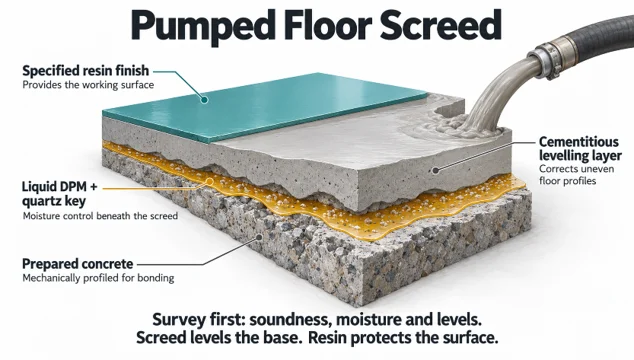
What Is Pumped Floor Screed? A UK Guide
A pumped floor screed is a cement-based layer pumped onto prepared concrete. It brings a deteriorated, broken or uneven floor back to level. The screed is an engineered base, not an exposed wearing surface. It remedies profile variations so that a durable resin finish can carry daily site traffic. Get the base wrong and the finish above it fails early.
Irregular floors hinder automated equipment and stop coatings bonding properly. Puddles accumulate during washdown. Forklift wheels take a beating. How do pump screed contractors determine whether your concrete needs a total pumped screed build-up before the resin goes down?
- A pumped cementitious screed creates a true level plane across uneven concrete before robust resin finishes are applied.
- The screed serves as a levelling layer underneath, never as the exposed wearing surface in an industrial facility.
- FeRFA classifications include synthetic resin flooring only and never relate to cementitious pumped screeds or anhydrite underlayments.
- A liquid damp proof membrane stops rising moisture forcing the sealed resin floor away from its base.
- Pricing and scope come from a physical site survey, never from floor area measurements alone.
Pumped Screed and Resin Finish Compared
Cementitious pumped compounds level a floor quickly across extensive commercial areas. They fix surface irregularity and produce a uniform plane for resin toppings. The two materials sit in the same build-up but do very distinct jobs. Facilities managers who appreciate that difference specify the proper floor build-up first time, rather than paying twice.
The table below compares a pumped cementitious levelling screed with the resin finish that seals it. In practice, we notice that most specification errors begin here. One material reinstates geometry. The other bears traffic, chemical attack and cleaning regimes across a working industrial site.
| Property | Pumped Cementitious Screed | Specified Resin Finish |
|---|---|---|
| Primary Function | Substrate levelling and profile correction | Wear resistance, chemical protection and slip safety |
| Material Base | Polymer-modified cementitious compound | Synthetic resin (epoxy, polyurethane, polyaspartic) |
| FeRFA Classification | Not applicable (cementitious product) | FeRFA Types 1 through 8 |
| Surface Role | Engineered base layer for subsequent systems | Exposed working traffic surface |
| Moisture Function | Receives resin above an isolating membrane | Provides a seamless, non-porous barrier |
Pumped Screeds Compared With Resin Systems
Cement-Based Screeds and Synthetic Resin Floors
A cementitious pumped screed is not a resin screed. It is not a self-smoothing resin floor either. Cement-based compounds employ water and hydraulic binders to hydrate into a flat, firm base. Synthetic resin floors employ chemical polymers. They offer seamless abrasion resistance directly under busy workplace traffic.
Conflating the two triggers expensive specification errors. Resin systems must be placed over sound, flat profiles. They are not bulk levelling materials. Levelling pronounced undulations with high-performance resin is cost-prohibitive. The cementitious material remedies surface deviation. The resin then withstands chemical attack and mechanical abrasion.
Classification Boundaries and Domestic Screed Products
Never give a FeRFA type to a cementitious screed. FeRFA classifies synthetic resin flooring only. Its eight categories cover resin matrices from thin floor seals through to heavy-duty polyurethane screeds. Cementitious levelling layers sit under British Standards for screeds instead. They remain outside the resin classification framework entirely.
Commercial pumped screeds also differ from the liquid anhydrite screeds used in domestic underfloor heating. Anhydrite screeds incorporate gypsum. They dry slowly and stay reactive to moisture. Industrial cementitious screeds dry predictably and produce a solid sub-base for impermeable resin topcoats. Neither product should be confused with structural concrete.
Substrate Conditions That Require a Pumped Screed
Failed In Situ Screeds and Damaged Concrete
A failed in situ screed is an unstable foundation. It cannot bear a subsequent finish. Weak, debonding or disintegrating screed must be cleared back to sound concrete first. Cracking, hollow areas underfoot and flaking arrises all point to systemic failure. That failure necessitates full mechanical breakout and a pumped replacement.
Degraded concrete presents impact craters, deep gouges and spalled joint shoulders. Constant forklift movement causes most of it. Patching these defects locally across a sizeable area creates differential movement. A continuous pumped screed bridges the variation and fills deep voids. It re-establishes a flat plane that protects vehicle running gear and the concrete beneath.
Undulating Floors and Dusting Concrete Surfaces
Undulating concrete upsets racking lines and makes material handling equipment rock. It also leaves standing water during washdown. Thin coatings replicate every hollow and crest in the slab below. A pumped screed delivers true surface regularity across broad open floor plates before any seamless finish is applied.
Weak or dusting concrete has poor surface cohesion. Improper curing or excess water during placement is the usual cause. The friable laitance releases fine dust under every pass of a wheel. Pumping a screed over mechanically keyed, sound concrete covers the subfloor. The result is a firm layer ready to accept a durable resin system.
Did You Know?
Regulation 12 of the Workplace (Health, Safety and Welfare) Regulations 1992 requires every floor to be suitable for its purpose. It must not be uneven, holed or sloping to an extent that exposes anyone to risk. Floor condition is a legal duty, not a maintenance preference.
Floor Build-Up Sequence, Layer by Layer
Mechanical Preparation and Substrate Profiling
Mechanical preparation must expose aggregate before any primer or screed reaches the floor. Captive shot blasting or diamond grinding clears weak laitance, dirt, aged coatings and curing agents. The impact opens the concrete pores. What remains is a textured profile that gives the applied layers a firm mechanical key.
The choice between shot blasting and diamond grinding depends on site conditions and contaminants. Shot blasting profiles vast expanses of open concrete quickly. It propels steel shot into the matrix and collects the debris in one pass. Near ongoing operations, concrete floor grinding with HEPA dust control creates an open-pored bonding plane without significant vibration.
Membrane, Quartz Key and the Screed Pour
Installers apply a liquid damp proof membrane once preparation is concluded. Technicians scatter quartz aggregate into the wet resin immediately. Once that layer cures, the quartz grains create an aggressive mechanical key. The crew then mixes the screed continuously and pumps it into position. They rake it to datum pins and smooth it to level.
The screed cures to an accurate level plane. Moisture and soundness checks follow before the specified resin finish goes down. The client may pick a high-build epoxy coating, a self-smoothing surface or a heavy-duty polyurethane screed. In every case the resin bonds permanently to the keyed screed, establishing one cohesive assembly.
Moisture Control and Membrane Requirements
Why the Damp Proof Membrane Is Never Optional
A damp proof membrane is never optional beneath an impermeable resin finish. Moisture leaving a damp concrete slab causes hydrostatic pressure under the topcoat. Without an isolating barrier, that pressure prises the sealed resin floor clean off its base. Blistering, adhesive delamination and wholesale detachment ensue.
A specialised liquid DPM forms an impenetrable barrier across the prepared concrete. Technicians apply an epoxy membrane directly onto the profiled slab and broadcast quartz into the uncured film. That step isolates every layer above from ground moisture. Residual building dampness then cannot pass upward and wreck the topcoat bond.
Hygrometer Testing and Moisture Thresholds
Quantitative hygrometer testing provides the data necessary before anything is specified. Visual checks signify nothing, because a dry-looking surface often conceals a saturated slab. Technicians seal hygrometer boxes to the prepared concrete and measure equilibrium relative humidity. The readings indicate whether the floor needs a high-performance Pumped Screed Flooring barrier membrane.
Ordinary resin formulations handle roughly 75% to 80% relative humidity within the slab. Readings above that range need a durable liquid membrane rated to suppress moisture up to 98% relative humidity. Skipping the test provokes premature bond line failure. Emergency remediation then costs far more than the testing ever would.
Industrial and Commercial Applications
Warehouses, Logistics and Distribution Centres
Warehouses and logistics hubs need outstanding surface regularity. High-bay forklift safety and automated sorting both depend on it. Uneven profiles rock material handling equipment, damage steering components and trigger joint impact damage. A pumped screed flattens transit aisles and marshalling areas before the forklift-rated resin coating is applied.
A pumped screed levels the building. It does not, on its own, make the floor heavy duty. Pump screed contractors should examine vehicle traffic before guaranteeing anything. Concentrated point loads from solid nylon pallet truck wheels need a particular epoxy or polyurethane finish above the screed. The screed provides geometric tolerance. The resin resists abrasion and wheel shear.
Manufacturing Plants, Workshops and Fit-Outs
Manufacturing plants and precision workshops often run on concrete changed by decades of change. Machinery relocations, service trenching and chemical spillage all leave their mark. A pumped screed recovers level continuity across reconfigured assembly areas. It creates a secure platform for resin toppings that resist oil, dropped tools and metal swarf.
Commercial fit-outs turn unfinished industrial units into showrooms, laboratories or retail space. A pumped screed eliminates steps, unused drainage troughs and irregular contours quickly. Paired with a self-smoothing or decorative resin finish, the build-up delivers a clean, hygienic surface. It addresses both workplace safety duties and the appearance standards the occupier demands.
Survey Procedures That Define Project Scope
Soundness, Moisture and Contamination Mapping
Scope comes from a physical survey, never from floor area alone. Surveyors employ rebound hammers or scratch testing to confirm the compressive strength of the slab. Weak, carbonated or friable concrete cannot support a bonded screed. Those areas are mapped for intensive removal before any pricing is discussed.
Deep chemical contamination also needs mapping. Concrete soaked in cutting oils, hydraulic fluid or process chemicals refuses bonding agents. Specialists must degrease or scarify the matrix down to clean material first. From experience across the sector, contamination mapping and hygrometer testing together dictate the ultimate build-up.
Level Mapping, Joints and Door Thresholds
Laser level mapping detects high spots and low undulations across the workspace. Technicians map the variation to compute the accurate screed volume required for a unified plane. Visual estimates lead to material shortfalls or thin coverage over high spots during the pour. Careful mapping removes that risk entirely.
A survey also examines floor joints, perimeter thresholds, access ramps and drainage channels. Existing movement joints must carry through the screed and the resin above, rather than being bridged rigidly. Door thresholds, machine plinths and gullies govern the boundary details. Chased anchor grooves finish the screed flush with surrounding fixtures.
Installation Programmes and Project Milestones
Daily Placement Rates and Site Access
Up to 1,000 square metres of screed can be placed in a single day across open floor area. That rate depends on three things. Mechanical preparation must be done and primer membranes must have cured. The crew also needs unobstructed hose access from the mixer unit outside.
That figure measures the screed layer alone. It is not the duration of the job. Substrate preparation, crack repair, membrane priming, quartz scatter and the multi-coat resin finish each demand their own window. Viewing a pumping rate as a project timeframe creates operational plans that unravel on day one.
Walk-On Time, Overcoating and Full Traffic
Walk-on time, readiness to overcoat and return to full traffic are three different milestones. Foot traffic onto freshly placed screed is permissible relatively early. That does not mean the screed will take a resin coating. Nor does it signify the floor can take heavy plant loads yet.
Readiness to overcoat requires validated moisture testing of the screed itself. The material must have cured enough to accept an impermeable resin topping without retaining water. Return to full traffic is the ultimate milestone. It covers heavy forklifts and aggressive cleaning chemicals, and it is commissioned only once the resin finish reaches full cure.
Final Thoughts
A pumped floor screed renews damaged, undulating or poorly finished industrial subfloors. Pumping a high-strength cementitious compound across prepared concrete eliminates undulation and surface degradation in one seamless operation. The screed handles geometry and subfloor integrity only. It does not replace the protective qualities of an industrial resin floor.
The screed corrects the base. The specified resin finish withstands the service conditions. Facilities managers obtain the best result when they treat a floor as one combined, multi-layer system. Mechanical profiling, moisture isolation, pumped levelling and resin coatings work together to create a compliant, durable workplace floor.
Frequently Asked Questions
Q: What is pumped screed flooring within an industrial facility?
A: Industrial pumped screed flooring is a flowable, polymer-modified cementitious compound. It is mixed on site and pumped through hoses onto prepared concrete. The purpose is to level undulating, worn or rough slabs quickly across big floor plates. In an industrial setting it acts as an underlayment that rectifies the surface plane. It is not the final traffic surface. Once cured, installers seal it beneath a resin system that tolerates traffic, spillage and regular washdown.
Q: Can a pumped screed be left as the finished working floor?
A: No. A pumped cementitious screed is a base layer, not a wearing surface. It provides compressive strength and recovers flatness, but it stays porous. Under industrial traffic it is prone to chemical staining, liquid penetration and surface dusting. For long-term serviceability, contractors seal the cured screed beneath a purpose-made resin finish. High-build epoxy and polyurethane coatings are the common options. Both resist wheel abrasion, chemical spills and regular mechanical cleaning.
Q: How much does a pumped floor screed cost per square metre?
A: There is no generic rate per square metre. Scope derives entirely from a site survey. Cost depends on the mechanical preparation needed and the extent of substrate repair. The depth of undulation correction and pump access logistics also matter. Substrate moisture readings and the specified resin topcoat shape the figure too. Reliable pricing follows a physical assessment of the building. It cannot be calculated from floor area dimensions alone.
Q: Why is a damp proof membrane needed underneath the screed?
A: Moisture leaving a concrete slab creates hydrostatic pressure. That pressure pushes a sealed resin topcoat away from the floor. A liquid epoxy membrane applied directly to prepared concrete establishes an impermeable barrier against rising damp. Quartz aggregate scattered into the wet membrane then creates the mechanical key for the pumped screed above. The whole multi-layer assembly stays bonded. Without the membrane, osmotic blistering and delamination become a matter of time.
Q: Will a pumped screed make weak concrete structurally stronger?
A: No. A pumped screed shields the concrete and reinstates surface flatness. It gives no structural load-bearing capacity to the building. If the slab displays structural movement, subsidence or dynamic cracking, a screed will not remedy it. The same applies to limited slab depth. The substrate needs sufficient compressive strength and sound ground support before any screed is placed. Otherwise movement in the subfloor reflects straight back up through the screed and the resin finish.
Tags: pumped floor screed, pump screed contractors, what is pumped screed flooring, industrial floor screed, cementitious screed, resin flooring preparation, concrete levelling, damp proof membrane
Industrial Resin Flooring Contractors Network
- Chester Industrial Resin Flooring Contractor
- Northwich Industrial Resin Flooring Contractor
- Runcorn Industrial Resin Flooring Contractor
- Warrington Industrial Resin Flooring Contractor
- Widnes Industrial Resin Flooring Contractor
- Winsford Industrial Resin Flooring Contractor
- Knutsford Industrial Resin Flooring Contractor
- Middlewich Industrial Resin Flooring Contractor
- Kirkby Industrial Resin Flooring Contractor
- Southport Industrial Resin Flooring Contractor
- St Helens Industrial Resin Flooring Contractor
- Flint Industrial Resin Flooring Contractor
- Mold Industrial Resin Flooring Contractor
- Deeside Industrial Resin Flooring Contractor
- Chirk Industrial Resin Flooring Contractor
- Wrexham Industrial Resin Flooring Contractor
- Mansfield Industrial Resin Flooring Contractor
- Crewe Industrial Resin Flooring Contractor
- Ellesmere Port Industrial Resin Flooring Contractor
- Newark-on-Trent Industrial Resin Flooring Contractor
- Nottingham Industrial Resin Flooring Contractor
- Sutton-in-Ashfield Industrial Resin Flooring Contractor
- Worksop Industrial Resin Flooring Contractor
- Mexborough Industrial Resin Flooring Contractor
- Rotherham Industrial Resin Flooring Contractor
- Sheffield Industrial Resin Flooring Contractor
- Swinton, South Yorkshire Industrial Resin Flooring Contractor
- Doncaster Industrial Resin Flooring Contractor
- Coventry Industrial Resin Flooring Contractor
- Dudley Industrial Resin Flooring Contractor
- Solihull Industrial Resin Flooring Contractor
- Walsall Industrial Resin Flooring Contractor
- West Bromwich Industrial Resin Flooring Contractor
- Wolverhampton Industrial Resin Flooring Contractor
- Bury Industrial Resin Flooring Contractor
- Denton Industrial Resin Flooring Contractor
- Eccles Industrial Resin Flooring Contractor
- Heywood Industrial Resin Flooring Contractor
- Hyde Industrial Resin Flooring Contractor
- Irlam Industrial Resin Flooring Contractor
- Leigh Industrial Resin Flooring Contractor
- Middleton Industrial Resin Flooring Contractor
- Oldham Industrial Resin Flooring Contractor
- Rochdale Industrial Resin Flooring Contractor
- Salford Industrial Resin Flooring Contractor
- Stockport Industrial Resin Flooring Contractor
- Stretford Industrial Resin Flooring Contractor
- Urmston Industrial Resin Flooring Contractor
- Swinton Industrial Resin Flooring Contractor
- Westhoughton Industrial Resin Flooring Contractor
- Wigan Industrial Resin Flooring Contractor
- Thorne Industrial Resin Flooring Contractor
- Chorley Industrial Resin Flooring Contractor
- Fleetwood Industrial Resin Flooring Contractor
- Lancaster Industrial Resin Flooring Contractor
- Leyland Industrial Resin Flooring Contractor
- Morecambe Industrial Resin Flooring Contractor
- Nelson Industrial Resin Flooring Contractor
- Preston Industrial Resin Flooring Contractor
- Skelmersdale Industrial Resin Flooring Contractor
- Chesterfield Industrial Resin Flooring Contractor
- Derby Industrial Resin Flooring Contractor
- Ilkeston Industrial Resin Flooring Contractor
- Swadlincote Industrial Resin Flooring Contractor
- Accrington Industrial Resin Flooring Contractor
- Altrincham Industrial Resin Flooring Contractor
- Ashton-under-Lyne Industrial Resin Flooring Contractor
- Atherton Industrial Resin Flooring Contractor
- Barnsley Industrial Resin Flooring Contractor
- Birmingham Industrial Resin Flooring Contractor
- Birkenhead Industrial Resin Flooring Contractor
- Blackburn Industrial Resin Flooring Contractor
- Blackpool Industrial Resin Flooring Contractor
- Bolton Industrial Resin Flooring Contractor
- Alfreton Industrial Resin Flooring Contractor
- Bootle Industrial Resin Flooring Contractor
- Burnley Industrial Resin Flooring Contractor
- Huddersfield Industrial Resin Flooring Contractor
- Bradford Industrial Resin Flooring Contractor
- Wakefield Industrial Resin Flooring Contractor
- Halifax Industrial Resin Flooring Contractor
- Dewsbury Industrial Resin Flooring Contractor
- Castleford Industrial Resin Flooring Contractor
- Pontefract Industrial Resin Flooring Contractor
- Coalville Industrial Resin Flooring Contractor
- Macclesfield Industrial Resin Flooring Contractor
- Hinckley Industrial Resin Flooring Contractor
- Manchester Industrial Resin Flooring Contractor
- Liverpool Industrial Resin Flooring Contractor
- Leicester Industrial Resin Flooring Contractor
- Leeds Industrial Resin Flooring Contractor
- Loughborough Industrial Resin Flooring Contractor
- Market Harborough Industrial Resin Flooring Contractor